
Essential Rating
Denominator’s Essential rating is for companies where there is limited or no diversity equity and inclusion data available. This rating is therefore often used for private companies or publicly listed companies that have not yet been researched by denominators technology or analysts. Because the essential rating model It is built for companies with limited diversity equity and inclusion data it relies more heavily on proxy data than the advanced rating.
In a world where DEI data disclosures are not standardized, proxy data can be a powerful tool to acquire signals of DEI performance. Proxy data is not directly attributable to the company that is being rated but services in place of variables that were not disclosed. As an alternative to having decision-making inhibited by a lack of data, proxy data enables assessments of the DEI landscape despite this.
Denominator’s Essential scores is calculated by looking at the company’s available DEI data, country score, industry score and other companies in same country’s DEI performance.
The essential rating is available for Denominators entire data universe and is especially useful for private company analysis. Given the large reliance on proxies it is however important to remember that the essential total scores or sub scores are only signals and doesn't necessarily 100% reflect a specific company's unique performance. Given the data reality it is however the best option and using proxy data is already a common and widely accepted approach for creating financial scores and ratings to assess financial risk on small and/or private companies that have limited financial disclosures available.
Any company can contact Denominator for access to their company profile and by providing their relevant DEI data it is possible to obtain an Advanced rating free of charge.
Advanced Rating
Denominator’s Advanced rating provides the most extensive rating based on a companies’ underlying DEI performance across the DEI Dimensions. Because DEI is a multi-dimensional concept ranging from diversity characteristics such as Gender, Race/Ethnicity, Age, Sexuality, Disability, Nationality, Religion, etc. to Inclusion characteristics such as Access and Opportunity, a rating trying to capture a level of DEI must include all the different DEI dimensions. The performance is both calculated at Board Level, Executive Level and the Company Level.
To conduct a comprehensive assessment of a company’s DEI performance the model also considers the macro-level DEI exposure of the company. This is a similar concept to financial risk assessments that doesn’t only consider the financials of a company, but also factors in country and industry risk.
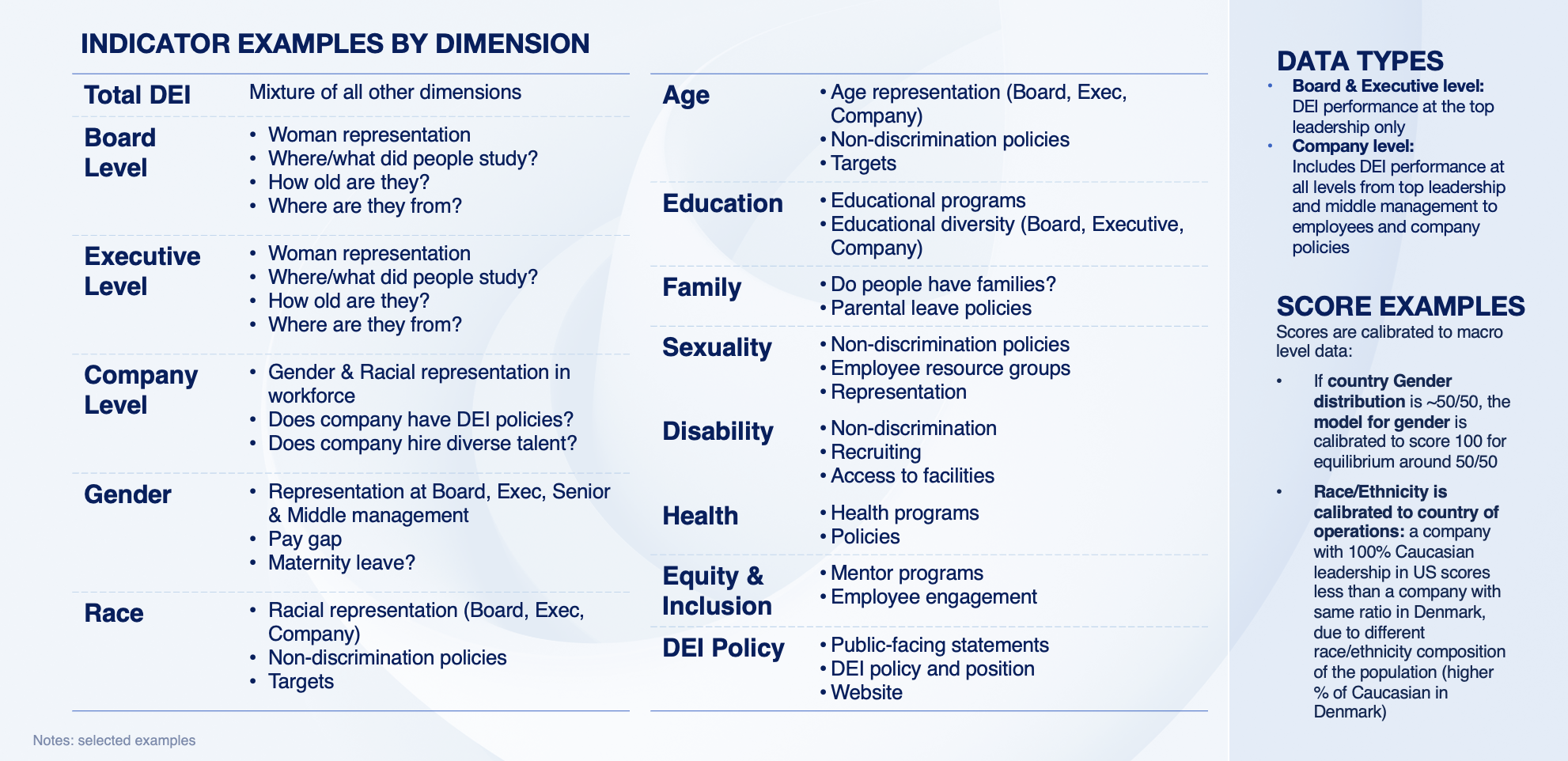
Please see below examples for some of the indicators that are going into each of the scores. This is not a full list, but is only intended to provide some general insight on how sophisticated the models are and that a number of indicators are affecting the final individual scores. For more details on the exact methodology please contact your Denominator representative or info@denominator.one
Data input to scores - examples
Sub-dimensions
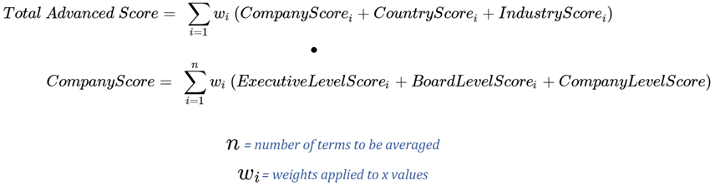
The Executive, Board and Company level is assessed in the holistic approach to DEI and each total score is calculated by adding the weighted sub-dimension into a final score.
DEI is not like financial risk where models have probability of default data available to calibrate against. For the Advanced Model, scores are therefore calibrated to Macro level data. See two examples below:
-
Race/Ethnicity score is calibrated to Race/Ethnicity numbers for company’s country or regions of operation. This means a company with 100% Caucasian leadership in US would get less points than a company with 100% Caucasian leadership in Denmark because the race/ethnicity composition of the two populations are different (more Caucasian population in Denmark).
-
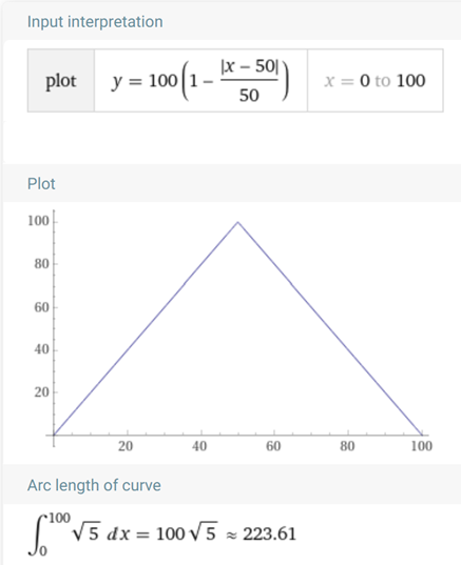
Women vs. Man distribution is around 50/50 across the global. The gender model is calibrated to provide score 100 for equilibrium around 50/50 and score 0 for 0/100 or 100/0 gender distribution: plot y=100*(1-abs(x-50)/50) from 0 to 100
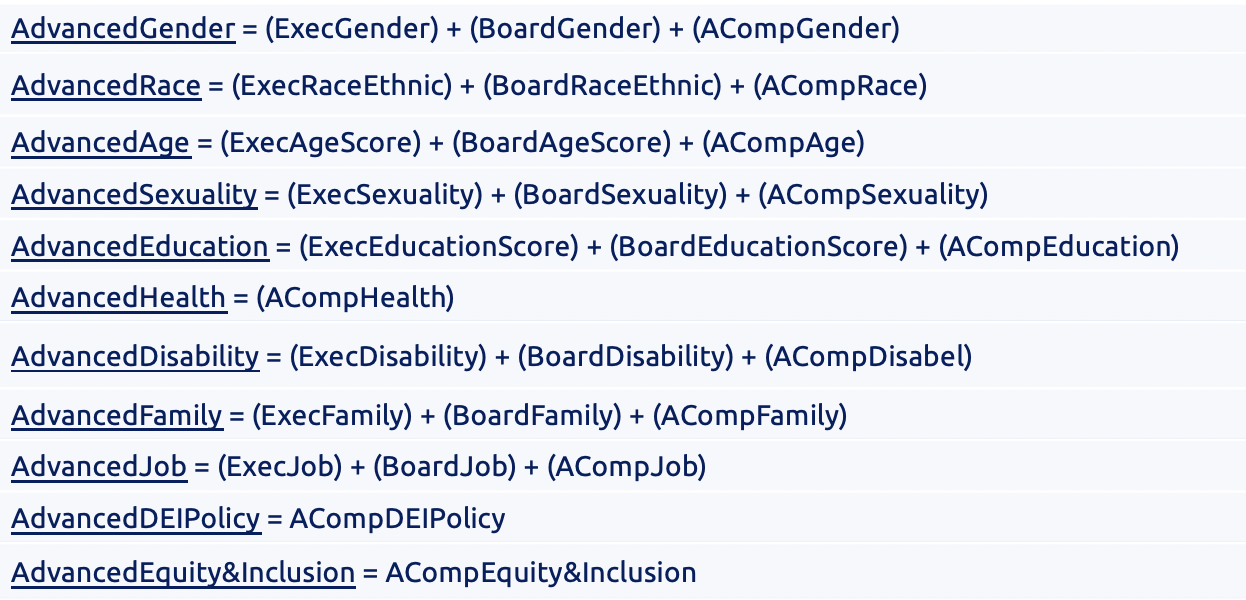
The Advanced sub-scores
Missing DEI data filing requirement: Model consequences
Countries have different data filing requirements for companies. Without standards, companies publish various levels of their own DEI data in the public domain. To account for this data reality Denominator has developed 3 separate models that can all be applied dependent on the users preference:
-
Advanced DM
-
Advanced M+
-
Advanced SME
Advanced DM
Advanced DM is a build on a “disclosed models” approach that relies on multiple sub-models each dependent on data availability. If a single static model approach was applied, companies with missing data would automatically receive a lower DEI score due to the loss of variables with weight percentages in the model. The Advanced VM models are however calibrated to ensure limited missing DEI datapoint won’t have a negative aggregate effect on the total score. This score will however have a lower strength indicator. Strength indicator = ∑ Available data / ∑ Total data. The Strength Indicator does not indicate the confidence in the model’s predictability for a company’s DEI level. It reflects the variations in DEI data reality and points to the degree of DEI details the model can take into account for each company.
As an example: If a company has not disclosed data on a certain DEI dimension (for example LGBTQ+), then then system relies on a secondary model that doesn’t contain LGBTQ+ dimension and the weight percentages of this dimension has been distributed on the remaining dimensions weights. Such a secondary model has a lower strength indicator.
Advanced M+
Advanced M+ relies on “modelled” data to substitute any missing data filings in the total model. The data is modelled on the filings of other companies in same industry and country or closest peer group possible. To penalize missing data transparency the lower quartile value of peer group is used instead of average or median.
As an example: If a company has not disclosed data on a variable in the model (for example Gender pay gap), then this model account for unavailable data by using estimated/modelled data from country and/or industry.
Advanced SME
Small and Medium sized Enterprises (SME) cannot be expected to have the same DEI initiatives as large companies. The Advanced SME model therefore excludes variables and signals which will not be available for SME’s and thereby creates a more direct performance scores for this group of entities. The Advanced SME model follows same modelled approach as Advanced M+. SMEs will still have Advanced VM and M+ scores available, but large entities will not have SME scores available.
As an example: A small start-up company cannot be expected to have a full time DEI officer employed. This indicator is therefore removed from the total model and its weights distributed to the other SME model indicators.